


How Resolution Plans Should Be Prepared to Maximise Votes under the Insolvency and Bankruptcy Code, 2016
I. Why Legally Compliant Resolution Plans Frequently Fail
One of the most common but flawed assumptions in insolvency practice is that a resolution plan which complies with Section 30(2) of the Insolvency and Bankruptcy Code, 2016 (“IBC”) will, by that fact alone, secure approval from the Committee of Creditors (“CoC”). Empirical experience under the Code demonstrates the contrary. A substantial number of resolution plans that are legally compliant and procedurally impeccable fail at the voting stage.
The explanation lies in the design of the IBC itself. The Supreme Court has consistently characterised the Code as a creditor-driven legislation, where the commercial fate of the corporate debtor is entrusted to financial creditors acting collectively through the CoC. Judicial bodies are not intended to function as appellate authorities over commercial outcomes; their role is confined to ensuring adherence to statutory requirements.¹
A resolution plan must therefore be understood not merely as a compliance document but as a commercial restructuring proposal, intended to persuade creditors who bear financial risk. Drafting for compliance alone ensures admissibility before the Adjudicating Authority; it does not ensure acceptability before the CoC.
II. The Committee of Creditors as the Sole Commercial Decision-Maker
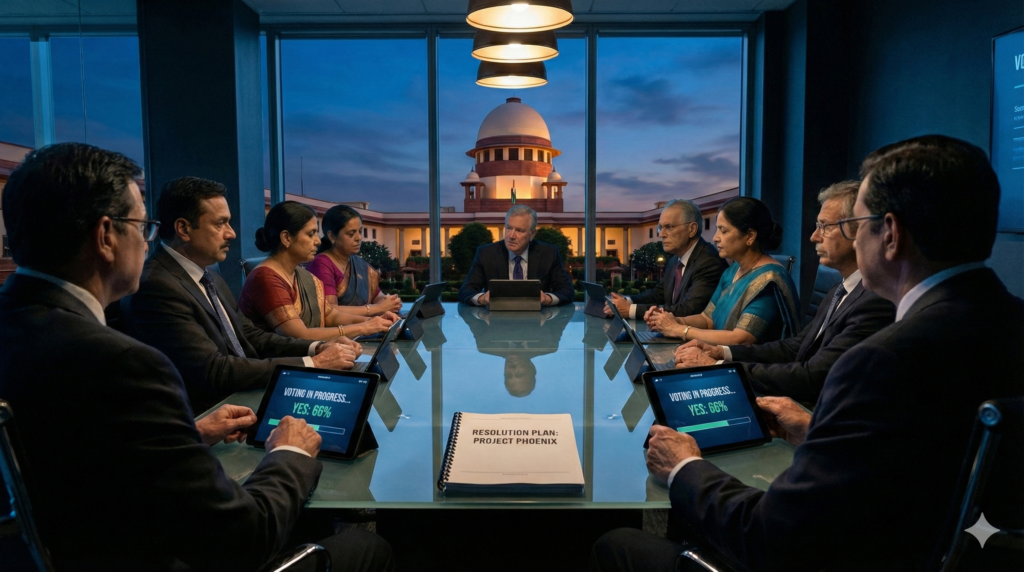
Within a Corporate Insolvency Resolution Process (“CIRP”), the CoC occupies a determinative position. Its role is neither advisory nor supervisory. Voting is conducted strictly on the basis of the value of admitted financial debt, and once the prescribed voting threshold—currently 66 per cent—is achieved, the decision is final and binding.
In K. Sashidhar v. Indian Overseas Bank, the Supreme Court held that once the requisite majority of the CoC approves or rejects a resolution plan, the Adjudicating Authority has no jurisdiction to question the merits of that decision.² This principle was authoritatively reaffirmed in Committee of Creditors of Essar Steel India Ltd. v. Satish Kumar Gupta, where the Court emphasised that the commercial wisdom of the CoC is paramount and insulated from judicial substitution.³
For resolution applicants, this jurisprudence conveys a clear and practical lesson: legal arguments cannot compensate for commercial dissatisfaction at the CoC level. Votes, not pleadings, determine outcomes.
III. Section 30(2) as a Judicial Gatekeeper, Not a Commercial Benchmark
Section 30(2) of the IBC prescribes minimum statutory conditions that every resolution plan must satisfy, including payment of insolvency resolution process costs, protection of operational creditors, and compliance with applicable law. However, the Supreme Court has made it clear that this provision does not prescribe what creditors must accept; it merely defines the boundaries of judicial scrutiny.
In Essar Steel, the Court held that the Adjudicating Authority’s review is confined strictly to the parameters enumerated in Section 30(2). Commercial considerations such as adequacy of recovery, valuation comparisons, and feasibility assessments fall outside judicial review.³ This position was further reinforced in Maharashtra Seamless Ltd. v. Padmanabhan Venkatesh, where the Court rejected the argument that a resolution plan must necessarily match or exceed liquidation value, provided it has been approved by the CoC.⁴
Section 30(2), therefore, operates as a legal floor, not a commercial target. Compliance ensures that a plan can be placed before the tribunal; it does not determine whether creditors will vote in its favour.
IV. Claim Analysis as the Foundation of Voting Strategy
Every vote in the CoC is anchored to admitted claims, not claimed amounts, disputed figures, or contingent assertions. Resolution applicants who fail to ground their strategy in the admitted claims register are effectively operating without a reliable map of voting power.
Accurate claim analysis serves several critical functions. It determines voting share, defines minimum statutory entitlements under Section 30(2)(b), and reveals where economic power is concentrated. It also allows resolution applicants to identify swing creditors and anticipate potential dissent.
In India Resurgence ARC Pvt. Ltd. v. Amit Metaliks Ltd., the Supreme Court clarified that even dissenting secured financial creditors are entitled only to the minimum payment mandated under Section 30(2)(b) read with Section 53 of the IBC. They cannot demand enhanced recovery merely by reference to the value of their security.⁵ This judgment underscores the importance of distinguishing between legal entitlements and commercial leverage when structuring a resolution plan.
V. Why Financial Architecture Often Matters More Than Quantum
Creditors do not assess resolution plans solely on headline recovery numbers. In practice, they evaluate certainty, timing, enforceability, and risk allocation. An upfront payment with high certainty may be commercially preferable to a larger deferred payout burdened with conditions, contingencies, or optimistic assumptions.
The Supreme Court has consistently declined to interfere with such commercial structuring choices once approved by the CoC. In Maharashtra Seamless, the Court emphasised that valuation and payout structuring are matters of business judgment and do not invite judicial calibration.⁴
Effective resolution plans therefore prioritise clear payment timelines, limited conditionality, realistic cash-flow assumptions, and credible funding mechanisms. These elements frequently carry greater persuasive value than nominal recovery percentages.
VI. Equality under the IBC: Contextual, Not Mathematical
A recurring objection in CIRPs concerns alleged unequal treatment of creditors. The Supreme Court has decisively rejected the notion that the IBC mandates mathematical equality among creditors, even within the same class.
In Essar Steel, the Court held that equality under the IBC is contextual rather than absolute. Differential treatment is permissible so long as it is supported by a rational, non-arbitrary commercial rationale linked to security, priority, or risk exposure.³ What the Code prohibits is arbitrariness, not differentiation.
This principle affords resolution applicants the flexibility required to design commercially viable distributions while remaining within statutory boundaries.
VII. Secured Financial Creditors as Voting Anchors
In most CIRPs, secured financial creditors—primarily banks and financial institutions—hold decisive voting power. Their evaluation of a resolution plan extends beyond nominal recovery to include regulatory implications, enforceability of covenants, downside protection, and certainty of implementation.
Judicial deference to CoC decisions, as articulated in K. Sashidhar and Essar Steel, means that these creditors understand that their commercial judgment is unlikely to be disturbed post-approval.²³ This awareness makes them particularly exacting at the voting stage, reinforcing the need for resolution plans to address their commercial and regulatory concerns with precision.
VIII. Homebuyers as a Class: Value Prevails over Numbers
Homebuyers occupy a distinctive position under the IBC. Recognised as financial creditors in Pioneer Urban Land and Infrastructure Ltd. v. Union of India, they vote as a class through an Authorised Representative.⁶
In Jaypee Kensington Boulevard Apartments Welfare Association v. NBCC (India) Ltd., the Supreme Court clarified that the class decision is determined by value-based majority among responding creditors, not by numerical headcount.⁷ Individual dissatisfaction, unless it alters the value majority, has no determinative impact.
Resolution plans in real-estate CIRPs therefore succeed when they address possession timelines, construction certainty, and funding credibility—factors that influence value-holding allottees rather than sentiment alone.
IX. Operational and Government Creditors: Non-Voting but Strategically Relevant
Operational creditors and statutory authorities often lack decisive voting power, yet unresolved claims or regulatory exposure can undermine implementation. Financial creditors factor this downstream risk into their voting decisions.
In Ghanashyam Mishra & Sons Pvt. Ltd. v. Edelweiss Asset Reconstruction Co. Ltd., the Supreme Court affirmed the “clean slate” doctrine, holding that once a resolution plan is approved, all prior claims stand extinguished except as provided in the plan.⁸ This jurisprudence makes it imperative for resolution applicants to address such claims comprehensively at the planning stage, rather than treating them as peripheral concerns.
X. Execution Capability as a Voting Variable
Resolution plans are inherently forward-looking instruments. Creditors therefore assess not only the proposal, but the person proposing it. Track record, governance framework, and proof of funds frequently carry greater weight than aggressive projections or optimistic timelines.
The Supreme Court’s jurisprudence reinforces this approach by placing feasibility and viability assessments squarely within the CoC’s domain.³ Courts will not substitute their views on execution risk for that of creditors.
XI. Risk Allocation and Downside Protection
Uncertainty is the principal enemy of creditor approval. Resolution plans that clearly allocate risk—through contingency reserves, escrow arrangements, and defined treatment of future claims—tend to inspire greater confidence.
The finality accorded to approved plans in Ghanashyam Mishra reinforces the importance of resolving uncertainties ex ante rather than leaving them to post-approval disputes.⁸
XII. The Decisive Phase: Pre-Vote Engagement
Given the judiciary’s post-approval restraint, the decisive phase of a CIRP lies before voting. Early engagement, transparent disclosures, and responsiveness to creditor concerns frequently determine outcomes.
As Essar Steel makes clear, courts will not re-engineer commercial bargains after the fact.³ The negotiation table, not the courtroom, is where votes are secured.
XIII. Recurring Errors That Cost Votes
Resolution plans frequently fail due to unrealistic timelines, excessive reliance on future contingencies, neglect of dissent entitlements, or an assumption that litigation can substitute negotiation. Judgments such as India Resurgence and Maharashtra Seamless demonstrate that post-vote challenges rarely succeed on commercial grounds.⁵⁴
XIV. Voting Mathematics as Predictive Tool
Experienced resolution applicants model voting outcomes well in advance by mapping admitted claims and identifying swing creditors. Submitting a plan without understanding this arithmetic is a strategic misstep.
The Supreme Court’s emphasis on voting thresholds in K. Sashidhar and representative voting in Jaypee Kensington underscores that outcomes are determined by numbers, not narratives.²⁷
XV. Resolution Planning as Structured Commercial Negotiation
Supreme Court jurisprudence under the IBC conveys a consistent message: courts will not rescue commercially unconvincing resolution plans. The discipline of resolution planning lies in aligning statutory compliance with creditor economics, execution credibility, and risk management.
Maximising votes is not merely a drafting exercise. It is a structured commercial negotiation conducted within clearly defined legal limits. Those who internalise this reality consistently succeed under the Code.
Footnotes (Supreme Court of India)
- Swiss Ribbons Pvt. Ltd. v. Union of India, (2019) 4 SCC 17.
- K. Sashidhar v. Indian Overseas Bank, (2019) 12 SCC 150.
- Committee of Creditors of Essar Steel India Ltd. v. Satish Kumar Gupta, (2020) 8 SCC 531.
- Maharashtra Seamless Ltd. v. Padmanabhan Venkatesh, (2020) 11 SCC 467.
- India Resurgence ARC Pvt. Ltd. v. Amit Metaliks Ltd., (2021) 7 SCC 657.
- Pioneer Urban Land and Infrastructure Ltd. v. Union of India, (2019) 8 SCC 416.
- Jaypee Kensington Boulevard Apartments Welfare Association v. NBCC (India) Ltd., (2022) 1 SCC 401.
- Ghanashyam Mishra & Sons Pvt. Ltd. v. Edelweiss Asset Reconstruction Co. Ltd., (2021) 9 SCC 657.